The Text
The direct answer, for our own edition, is ten volumes out of ninety. Forty six come from Brenton's English Septuagint of 1851. Twenty eight come from the World English Bible. The rest arrive by other routes, one of them through Latin and one through Coptic.
We publish that breakdown book by book on our Sources and Methodology page, and it is worth saying plainly here, because the number sounds damning right up until you know which question it answers.
Two Questions That Keep Getting Merged
The Ethiopian Orthodox Tewahedo canon runs to 81 books. Any publisher can reproduce that list. Reproducing it says nothing whatever about where each book's English came from.
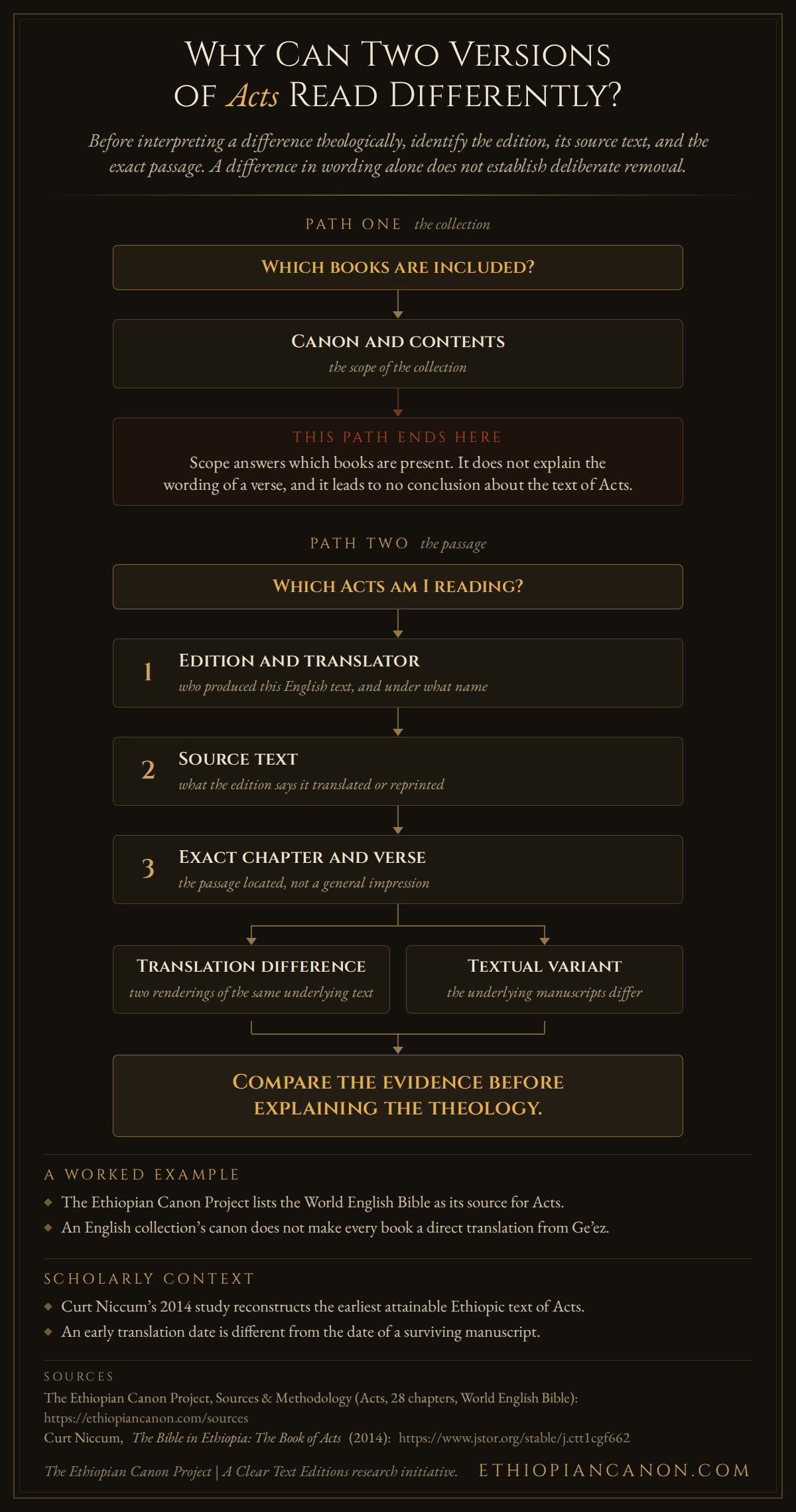
Canon is a question about the collection: which books are in, which are out, who decided. Source text is a question about one book at a time: what did this particular English wording get made from. An edition can be completely right about the first and still, quite properly, be printing a New Testament that came from a modern English Bible.
The two get merged constantly, and the merge is what produces the argument that runs "my Ethiopian Bible says something different in Acts, so Rome removed it." That conclusion needs the second question answered, and the title of the book on the table only answers the first.
Our Edition, Volume by Volume
The 81 canonical books are printed as 90 volumes, because the physical arrangement splits several grouped books apart. Here is where every one of those volumes gets its English.
| Volumes | Books | Where the English comes from | Crossed |
|---|---|---|---|
| 46 | The Old Testament, including 1 Esdras, Judith, Wisdom, Sirach and Baruch | Brenton's English Septuagint, 1851 | Greek |
| 28 | The 27 New Testament books, and Tobit in the long recension | World English Bible | Greek |
| 6 | Sirate Tsion, Te'ezaz, Gitzew, the 2nd Book of the Covenant, Qalementos, Didascalia | Horner 1904, Schodde 1885, Harden 1920, Guerrier and Grebaut 1913, Grebaut 1911 to 1920 | Ge'ez |
| 1 | The 1st Book of the Covenant | Cooper and Maclean, The Testament of Our Lord, 1902 | Syriac |
| 3 | 1, 2 and 3 Meqabyan | Wikisource Ge'ez translations, CC BY-SA 4.0 | Ge'ez |
| 2 | Jubilees, 1 Enoch | R.H. Charles, 1902 and 1912, restructured to the Ethiopian chapter divisions | Ge'ez |
| 1 | Abtilis | Henry Tattam, Apostolical Constitutions in Coptic, 1848 | Coptic |
| 1 | Ezra Sutuel | Revised Version Apocrypha, 1895 | Greek |
| 1 | Rest of the Words of Baruch | Our own translation, from René Basset’s French of 1893 and Dillmann’s Latin of 1866 | Ge'ez |
| 1 | Josippon | Munster 1541 and Breithaupt 1710, with the Alexander section from Budge 1896 | Latin |
Twelve volumes in that table reach English through a translator who sat with Ge'ez manuscripts. Nine of them directly. Three of them by relay, since the 2nd Book of the Covenant and Qalementos were carried from Ge'ez into French by Guerrier and Grebaut, and the Rest of the Words of Baruch by Rene Basset, before anyone brought them into English. The 1st Book of the Covenant is not among them at all: it reaches us from the Syriac, through Cooper and Maclean, because the Ethiopic recension of that book has never been put into English.
One row in that table used to say "Not stated", and it was ours. Our source record named Charles, the dates and the chapter restructuring we applied to Jubilees and 1 Enoch, but it did not record what Charles himself translated from. Applying our own test to ourselves is how we found that gap, and we have since closed it: Charles worked from the Ge'ez, correcting it against the Greek and Latin where he judged the Ethiopic to have gone wrong. The row now reads Ge'ez, and our edition says so on its own page before the text of Enoch begins.
One correction while we are marking our own work. An earlier version of this paragraph said our chapter divisions were set "by consulting Amharic and Ge'ez sources." That was wrong. No Ge'ez was consulted for the divisions. They follow the Ethiopian tradition as printed in modern Amharic editions and in the commentary tradition, and chapter divisions are facts about how a tradition sections a book rather than translated text. We have corrected it here, in the printed appendix and in the canon introduction.
What Ours Can and Cannot Be Cited For
It can be cited as a modern English reading edition of the full 81-book canon, with a named source for every book. That is what it is, and it is why the sources page exists in the first place.
It cannot be cited as evidence for what a Ge'ez manuscript says. If you want to argue that Ethiopic Acts reads differently from the Greek at a particular verse, our Acts is not your evidence, because our Acts is the World English Bible. The same holds for Genesis, the Psalms, the Gospels and every other book in those first two rows.
The distinction that matters
A composite reading edition puts the whole canon in front of a reader in modern English. It is not a witness to a manuscript tradition, and an honest one tells you so in its own source notes rather than leaving you to find out.
For Ethiopic Acts specifically, the work to cite is Curt Niccum's The Bible in Ethiopia: The Book of Acts (2014), which examines the history of the Ethiopic version and reconstructs its earliest attainable text. The publisher describes that version as evidence for the Greek Bible circulating in East Africa near the end of the fourth century.
Note what that does and does not establish. An early translation date is not the date of every surviving manuscript, and it does not make every reading in a much later printed edition original. The date of the translation and the age of the copy in your hands are two different facts.
Where Ge'ez Actually Shows Up
It shows up in the books almost no competing edition contains: the eight Books of Church Order, which sit at the end of the canon and are the reason the Ethiopian list runs past every other church's.
Sirate Tsion and Te'ezaz come from Rev. G. Horner's Statutes of the Apostles of 1904, translated from the Ge'ez. Gitzew comes from Prof. George H. Schodde in 1885. The Didascalia comes from J.M. Harden in 1920, who worked from several British Museum Ge'ez manuscripts and supersedes Platt's earlier incomplete version.
One book in that block is the exception worth naming. Abtilis reaches English through Henry Tattam's 1848 translation of 81 canons from the Coptic apostolic constitutions, not through Ge'ez at all. It sits in a Ge'ez-heavy neighbourhood and came by a different road, which is exactly the sort of thing a per-book source note exists to catch.
The Josippon is the other case that needs stating carefully. Ours is a 116-chapter English approximation of the Ethiopian recension's scope, built mainly from Munster's 1541 Latin and Breithaupt's 1710 Latin, with the Alexander material replaced by Budge's 1896 translation from a Ge'ez manuscript, and the chapter selection guided by Binyam's 2017 study. It is a reconstruction. Calling it a translation of the Ethiopian Josippon would be false.
The three books of Meqabyan come from the Wikisource Ge'ez translations, which are CC BY-SA 4.0 rather than public domain, so the contributors get attribution. You can read our 1 Meqabyan free without buying anything.
The Test You Can Run on Any Edition
Three checks, in order, and they take about a minute in the Look Inside preview.
- Is there a source note per book, or one sentence for the whole volume? Eighty one books do not share one source. An edition claiming otherwise has not done the work or is not describing it.
- Does it distinguish a translation from a reprint? "Rendered into modern English" and "translated from Ge'ez manuscripts" are different claims with different costs, and only one of them is cheap.
- Does it claim Church authorization? That is a claim about an institution, and it is verifiable. Treat an unverifiable one as an answer in itself.
Apply all three to ours. That is what the sources page is for, and it is the same page that tells you our Acts is the World English Bible.
Why This Matters for the Removal Argument
Someone opens two books, finds a verse worded differently, and concludes that a church removed a teaching. The chain has a missing link, and it is always the same one.
A difference between two English books is a difference between two English translators until somebody demonstrates it is a difference between two texts. Demonstrating that means naming both editions, naming the source behind each, fixing the exact chapter and verse, and then identifying which manuscripts support which reading. Only after all of that does the question become historical.
None of this diminishes the Ethiopic tradition. It is a serious textual witness, studied by serious people, and Niccum's book exists because the version genuinely bears on how the Greek Bible circulated in fourth-century East Africa. The point is narrower. Neither dismissing that witness nor attributing more to it than the evidence supports is a reading of the evidence. Both are ways of skipping it.
Questions People Actually Ask
Are the books in an English Ethiopian Bible translated from Ge'ez?
Usually only a minority of them. Most English editions of the Ethiopian canon assemble existing public domain English texts, because complete direct translations from Ge'ez do not exist for most books. In our edition, ten of the ninety volumes reach English through a translator who worked from Ge'ez manuscripts. The other eighty come through Greek, by way of Brenton's English Septuagint of 1851 or the World English Bible.
Is a book's canon the same question as its source text?
No. Canon is which books a collection contains. Source text is where an individual book's wording came from. An edition can reproduce the Ethiopian Orthodox Tewahedo Church's 81-book list exactly and still print an Acts that came from a modern English New Testament. Both facts can be true at once, and they answer different questions.
Which books in the Ethiopian canon come to English from Ge'ez?
In our edition: 1, 2 and 3 Meqabyan, from the Wikisource Ge'ez translations; and the Books of Church Order, namely Sirate Tsion and Te'ezaz from Horner's Statutes of the Apostles of 1904, Gitzew from Schodde in 1885, the Didascalia from Harden in 1920 translated from British Museum Ge'ez manuscripts, and the 2nd Book of the Covenant and Qalementos, which reached English through French. The 1st Book of the Covenant is not in that group: it comes from the Syriac, through Cooper and Maclean, because the Ethiopic recension of that book has never been put into English.
Does a wording difference between two Bibles prove a passage was removed?
Not on its own. Two translators can render the same underlying text differently, so a difference in English may be a translation difference rather than a textual one. Establishing that two texts differ requires identifying the editions, the source text behind each, the exact chapter and verse, and the manuscripts supporting each reading.
How do I check what an edition's source text actually is?
Look for a source note per book, not a single sentence about the edition as a whole. A trustworthy edition names, for each book, the translator and the date of the translation it used. If an edition names no sources, or names one source for 81 books, its title is doing work its contents cannot support.
What is a composite reading edition?
An edition assembled from several existing translations rather than translated from one manuscript tradition by one team. It is a legitimate way to put the full canon in a reader's hands in modern English. It is not evidence for any particular manuscript reading, and an honest one says so in its own source notes.
Related reading: